
Labour Gets It Done
The Appeal to fell a large section of Woodland in Marlhill Copse has been refused. The work for this from the original Planning Meeting over a year earlier right through to the hearing and the site visit involved many hours of hard work from Labour’s Ports wood councillor John Savage. As we approach the election period, Green Party literature tries to take credit for this work. The truth is that a Green candidate arrived on the first morning of the hearing, looking to get her photo in the Daily Echo and left a short while later.
“I would like to thank all the local residents who contributed to the appeal hearing and to the campaign to retain these trees. It was a really tough fight working with the council tree officers on this case, representing the interests of local residents and the special nature of the copse against the Airport’s seven person legal team
To be honest, I felt we were seen as very much the underdogs in the hearing and we were far from certain of a successful outcome. I think we were all expecting a longer wait for a decision but I am absolutely delighted at this brilliant result.
It shows what local councillors and officers can do when working with, and supporting local residents.” Cllr John Savage.
One local resident, Izzy Sargent, who attended both days of the appeal hearing said:
“We are delighted that the planning inspector has considered all the positions in this application so deeply and found that the proposal to fell almost all the trees in the Southern Edge of Marlhill Copse would spoil the character of the woodland and the visually distinctive skyline. However, we are frustrated that “aerodrome safeguarding” continues to be simultaneously not a “consideration” and part of the debate about whether these trees are allowed to live. Sadly, this is almost certainly not the end of this matter.”
Southampton International Airport Appeal Hearing for Permission to Fell over 100 trees in Marlhill Copse
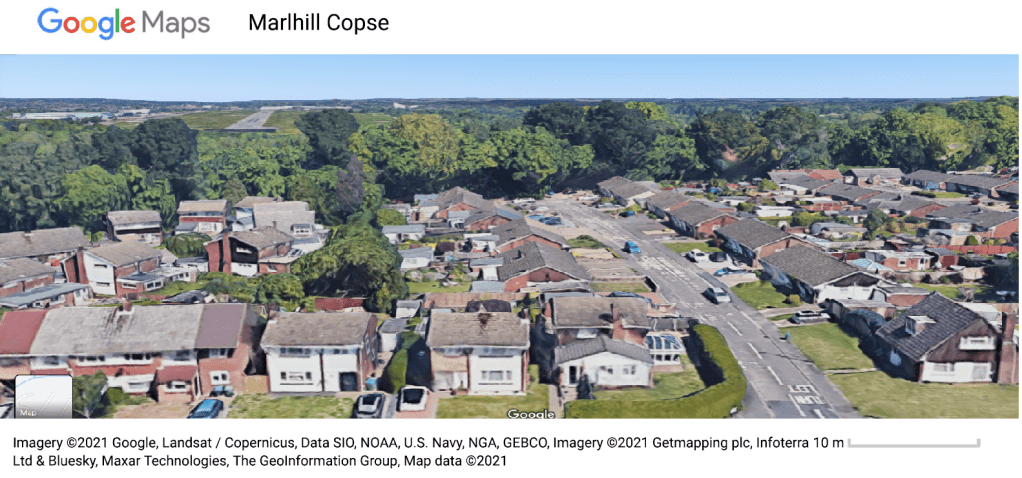
Around 5 years ago, Southampton International Airport, purchased Marlhill Copse. In March 2021 the Council Planning and Rights of Way panel decided to refuse an application by the airport to the felling of Monterey Pine, Corsican Pine and other coniferous species and all broadleaved species of trees within compartment 1a(i) (marked in black on the chart below).

The applicants, Southampton Airport, decided to appeal against that decision and on 2nd and 3rd November, the appeal hearing took place at the Ageas Bowl, Hilton Hotel in West End, Southampton.
The hearing is quasi-judicial and was overseen by a planning inspector whose job it is to determine whether the appeal is refused or upheld. I must apologize here for some of my terminology, as planning matters can be a little obtuse.
As a member of the original planning panel, I decided to attend and asked the planning inspector if I could present evidence at the hearing. The airport employed a legal team of around seven members including their own barrister, while Southampton City Council was represented by two tree officers and a council solicitor. In addition, several local residents attended, including members of Friends of the Earth.
The central arguments put forward by the Council to refuse the felling application were that the area proposed for felling included some of the most magnificent trees in Marlhill Copse, and indeed across Southampton. They provide a very significant visual amenity to local people who enjoy the woodland and are, in essence, the very “spirit of the place”. The trees form part of a heritage asset bounding the long-established woodland drive and are a key element of the conservation gardens in the copse. We also noted that Marlhill copse contains substantial areas of exotic trees and shrubs including camellias and rhododendrons. In addition, the area the airport wish to fell, totalling over 100 trees, provides significant capacity for carbon sequestration and the improvement of air quality as well as protection of an extensive badger sett within the roots and earth bank beneath the largest trees in that compartment. The trees in the threatened compartment are at the top of an escarpment on the southern edge of the copse bordering the access path and close to neighboring back garden fences.
The airport’s argument is that the removal of these trees will benefit the woodland as a whole; the broadleaf sycamores and the exotic tall pines being undesirable and inconsistent with the rest of the broadleaf woodland and incompatible with their published woodland management plan. The argument is that the tall pines, in particular, are not native and therefore are unwelcome. The plan is to replace all the trees in this area with smaller shrub-like native species.
To the opponents of the airport, it is very clear that the woodland plan and removal of these trees is to satisfy the airports longstanding aim to remove tall trees in line with the southern end of the airport, thus facilitating current and future aviation expansion plans. Their removal will punch a huge hole in the canopy cover destroying the feel of the place and even with replanting will not return to valuable enclosure from the sky for several generations. When the inspector asked why the airport didn’t just go through other legal routes to get the trees removed, for example write to the secretary of state requesting their removal, the airport barrister chose not to answer. He said, “we are choosing not to go down that route at the moment.”
In essence, the airport do not want to be accused of removing trees for aviation reasons but prefer to argue the removal of trees as part of good forestry practice.
It is my view that “the spirit of the place” is so valuable an amenity that it requires protection and should be preserved; and I drove home that argument. The airport legal team persisted with the use of clever but false arguments. Their barrister argued that following the removal of all trees in the contested compartment, carbon capture would actually be increased. What he meant was that, taking the woodland as a whole – which will of course grow over the next year – carbon capture will increase, but not by as much as it would do if the compartment was retained.
There was much play over the nature of developing a soft woodland edge, which is an important part of woodland management, if say a wood is in the middle of heathland. In my view, this is not an issue where the main path is just a few metres from the woodland edge located at the top of an escarpment and this was reinforced by the council tree officers and noted by the inspector.
In my view the moral and ethical argument was won by the Council officers and local residents but the decision on whether the trees are felled or not may rest on the some specific, purely legal arguments put forward by the Southampton Airport team. I believe the decision will be a difficult one for the planning inspector and is still very much in the balance. The decision is expected at the end of November 2022.


 johnsavage.org