
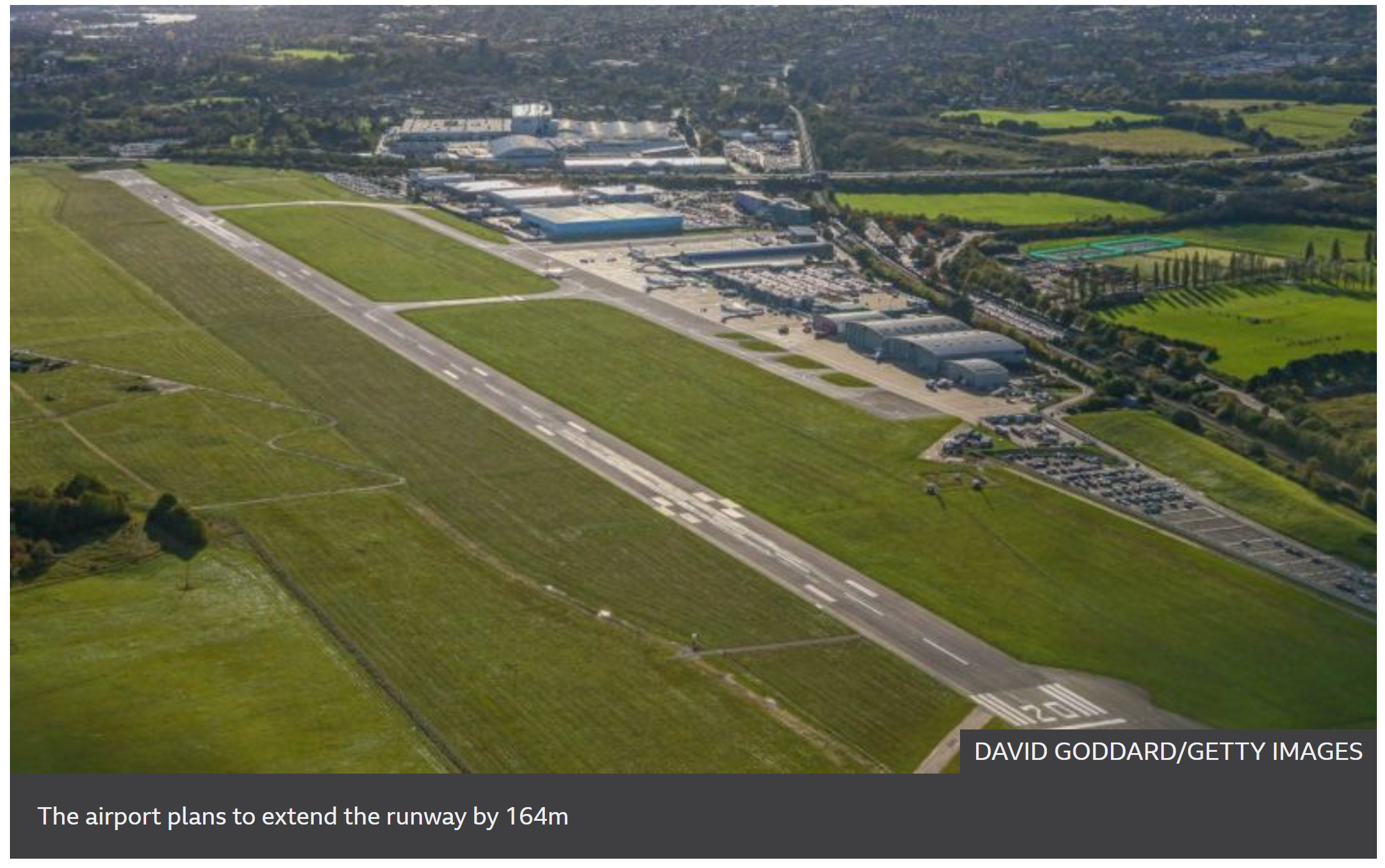
The fact is that the addition of 164m to the runway to facilitate larger and noisier jet aircraft (mainly A320s) will have a significant effect on everyone who lives nearby, whether they notice it or not. I was chair of the SCC panel looking at the application during the last round (Jan 2020) and with the current 2020 application, I can see no real difference for the panel to change their mind on this occasion.
Many people will discuss the issues around CO2 emissions and other pollution issues, but I have been looking at the issues around noise in particular.
Talking about noise levels is difficult. It is a technical business and is wrongly perceived as being personal and subjective. I remember, at an airport presentation, putting on some headphones and listening to a simulated A320 aircraft take-off in an area close to St Denys. It sounded pretty loud to me but the SIA member of staff told me that “People will just get used to it”.
Noise issues are poorly understood. In my day job I am employed by the University of Southampton as a Learning Developer and I have worked with acoustic engineers to improve classrooms and lecture spaces, where air conditioning units and poor acoustic environments have a negative impact on the learning experience.
Learners can filter out noise annoyance, they can concentrate more and use lip reading to help but I have experienced an acoustically poor environment and after an hour, the learner is exhausted. At 63 dB LaEq (16hrs) for example, the cognitive overload effect on memory and recall is the equivalent of twice the legal level of blood alcohol for driving a motor vehicle. The additional cognitive overload while you are trying to learn “difficult stuff”, even at 54 -57 dB (St Denys and Bitterne Park), places a burden on the learner which cannot be sustained. After hours of this, day after day learning outcomes are severely affected.
Academic papers have frequently recorded the effects of aircraft-based noise-pollution on learners.
“There are several ways in which aircraft noise could influence children’s cognition: lost teaching time – as a teacher may have to stop teaching whilst noise events occur; teacher and pupil frustration; annoyance and stress responses; reduced morale; impaired attention; children might tune out the aircraft noise and over-generalise this response to other sounds in their environment missing out on information; and sleep disturbance from home exposure which might cause performance effects the next day.” (report by Clark, 2015 p20).1
I have focused on the learning development of young people, but of course everyone is affected and it impacts the life experience and life expectancy of people in these areas.
The technical bit. To be clear, according to the airports plans, St Denys will suffer from an increase in the noise level from 51 up to 54 dB LaEq by 2021 and most of Bitterne Pk will increase to 57 (some parts up to 60) by the same year. Projected figures for 2033 are even higher and more widespread. Again this is difficult to understand because dB noise levels are on a logarithmic scale. A 10dB increase is equivalent to a doubling of noise levels.
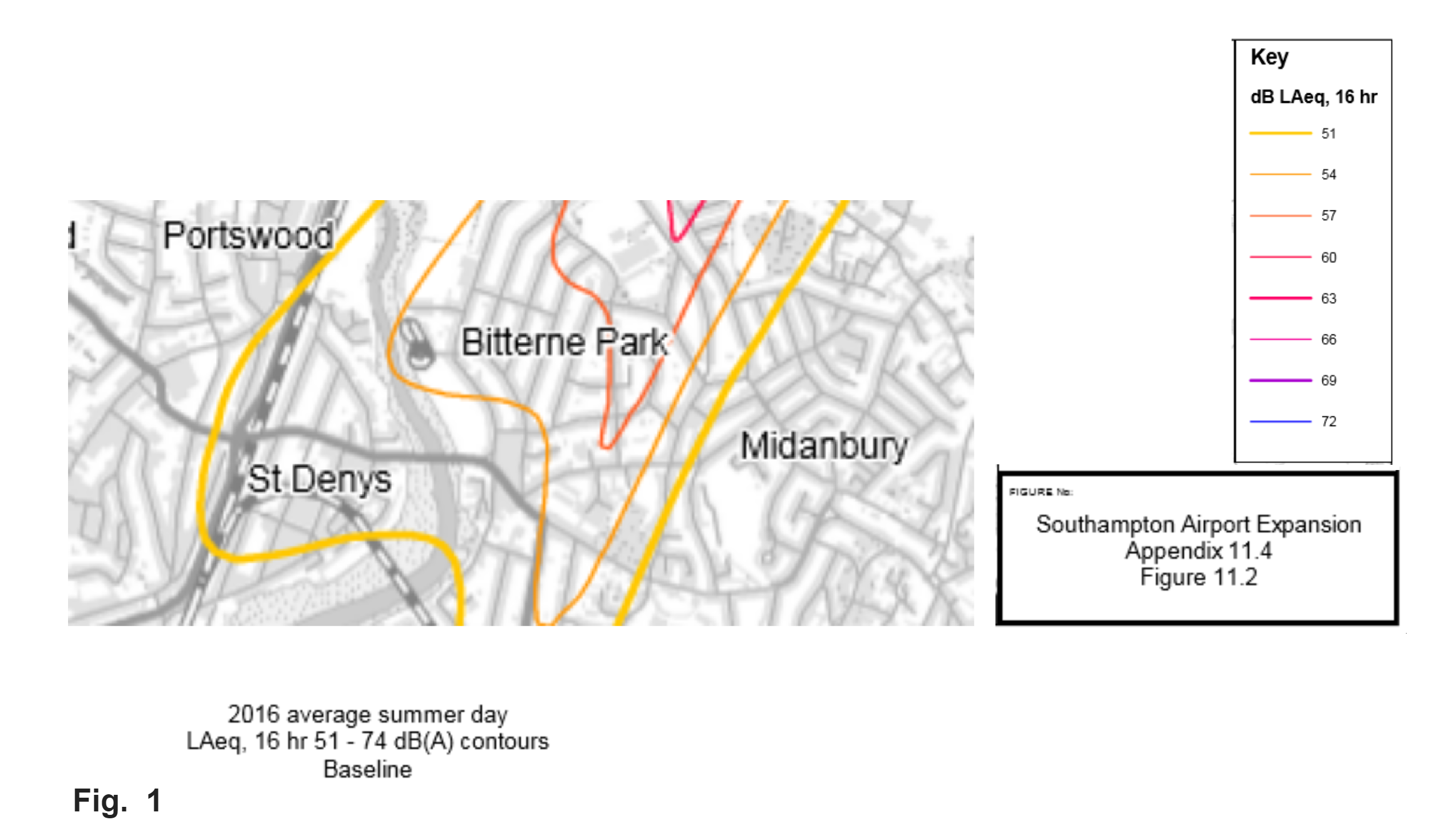
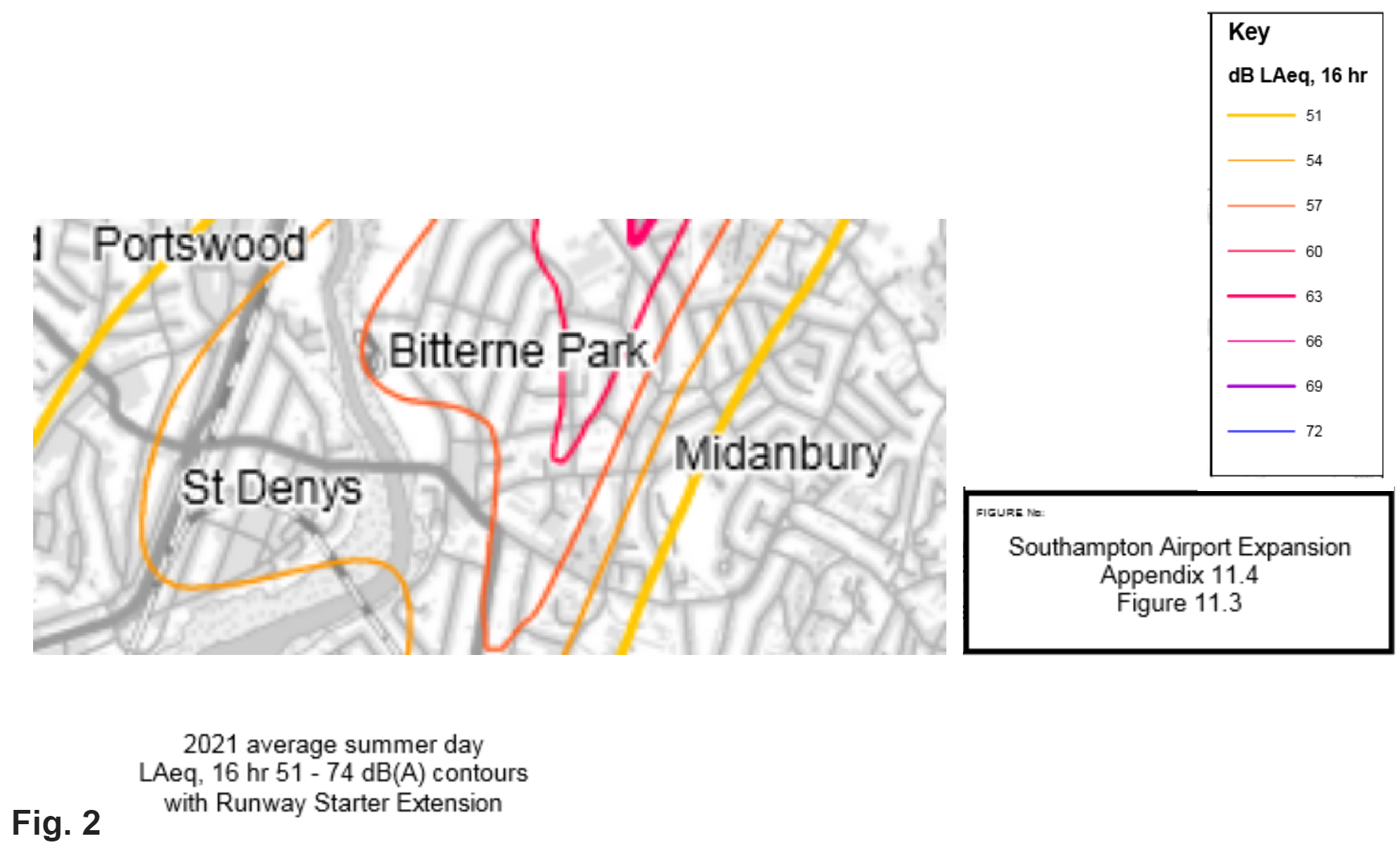
In addition, SCC environmental health officers judge these estimates to be highly conservative and much higher levels are likely.
Research shows (RANCH studies) that these noise levels reduce reading ages across a normal distribution by 2 stages on a -3 to +3 scale. (Road traffic and Aircraft Noise Exposure and Children’s Cognition and Health 2 ; and Health Consequences of Aircraft Noise 3).

Fig.3 Association of aircraft noise annoyance and reading comprehension. 3 (Kaltenbach, M. et al)
a) With increasing aircraft noise there is a linear decrease in silent reading comprehension.
b) The extent of subjective annoyance increases logarithmically.
The relationships are significant after factoring in the socioeconomic data.
Measuring noise pollution is a bit like measuring air pollution – it’s expressed as a 16 hour average – and ignores the peaks which cause the most distress and harm. What is needed are more detailed measurements required in order to fully understand how aircraft noise affects people, throughout the rhythm of the day and particularly at peak levels. 4 (Turner J, 2020)
Some people argue that this is a “nimby” attitude and that people who choose to live under a flight-path shouldn’t complain about the noise. But noise, as I have pointed out, isn’t simply annoying; it damages the lives of people and the young in particular; and remember, children who are born there have no say on the reduced life expectancies they will no doubt experience. The research cited above (Kaltenbach, M. et al) goes further, providing evidence of increased occurrence of cardio vascular disease relating to noise annoyance. Further, studies have shown that there is an absolute lack of evidence that soundproofing mitigation has any effect on these outcomes and recent DEFRA reports that the Lowest Observable Effect Levels (LOAEL) should be reduced to the range of 50 to 54 from the earlier 54 to 57 (dB LAeq, 16hr), exactly the range that would now be imposed on St Denys. These are now seen as having direct observable effects on the people who live there. It is important to note that while SIA are offering some compensation to mitigate the impact of aircraft noise at the 60 db LAeq contour, Gatwick 5 and Heathrow 6 are already offering compensation to households within the lower yet still damaging noise levels in the 57 dB contour area. Why should residents in these areas be compensated at these noise levels while residents in Southampton are not?
The other numbers are also important.

Fig.4 Households subject to 57db LAeq related to transport movements
The SCC report prepared in advance of the 1st December 2020 meeting compares noise impacts and mitigation at Gatwick Airport. At Gatwick there are 1,100 households subject to a noise level of greater than 57db LAeq (summer day average); but Gatwick delivers 46.5m passengers a year involving 283K air transport movements (ATMs) pa. If the plan were to go ahead, Southampton airport will have 2,900 households subject to a noise level of greater than 57db LAeq in order to deliver 3m passengers and 36K ATMs. This is almost 3 times the number of residents affected by noise for less than 6% of the business. 7 (Southampton City Council 1 December 2020 p18 para 5.14).
And this also means that since levels of noise are averaged out over the 16hr period, the actual flight noise will be about 17 times louder for residents on the ground. Try living with that.
Here is a quote from a local resident.
“I have lived in Manor Farm Road since 1999 and I am used to the Dash 8s doing their regular runs. The time when the noise stops my daily life is when the summertime chartered jets take off to the South. The noise is unbearable and I’m not in the highest noise category according to the map. Conversation is impossible, can’t hear the radio or TV, outdoor enjoyment is spoiled. I can’t imagine how bad it is in the schools in Bitterne Park, especially the secondary school. This, among other concerns, has led me to campaign against the runway extension and, if approved and implemented, means that I will probably be forced to move house.”
Regarding schools. the World Health Organisation (WHO) recommends no higher than 35 dB in classrooms and taken as a whole, the evidence supports the view that schools exposed to these projected levels of aircraft noise are not healthy educational or indeed living environments. As identified in Fig.3, the reading age and academic performance of young people is substantially and adversely affected by increased noise annoyance. This graph reflects seminal work and contributes to almost every academic paper on the subject. The bottom line is that aircraft noise ruins peoples lives and life chances. An increase of average daytime noise from say 47dB to 57dB is a doubling of average noise and studies show it reduces academic scores by a factor of 2 on a 6 point scale.
“There is sufficient evidence for a negative effect of aircraft noise exposure on children’s cognitive skills such as reading and memory, as well as on standardized academic test scores.”
and
“To date, few studies have evaluated the effects of persistent aircraft noise exposure throughout the child’s education, and there remains a need for longitudinal studies of aircraft noise exposure at school and educational outcomes.” 8 (Basner et al 2017)
Going back to my early meetings with the airport it is clear that none of this is being considered as part of the Airport plans. A view that “it will probably all be OK” or that “some double glazing will sort out the problem”, is clearly missing the point. The evidence shows that people’s lives will be directly damaged by the proposed changes and that double glazing is unlikely to help. There appears to be a clamour suggesting that increased international travel will bring about a welcome boost to the local economy and that locals will benefit from convenient travel to popular holiday destinations.
It is worth noting that across the City, this council monitors those deprived areas where mortality rates are far too high. Typically, these are associated with poor housing, lower educational outcomes, high rates of domestic violence and substance abuse and suicide, difficulties in policing and poor transport. The outcomes of all this leads to high levels of stress, cardiovascular disease, higher than average obesity rates and consequently higher mortality rates. The council rightly invests money into campaigns to improve outcomes for these residents. I believe that if the airport expansion goes ahead, there will be a sound-contour surrounding St Denys and Bitterne Park (and other areas) which in a few years time will match deprivation contours requiring even more investment to address the impact of negative life outcomes for residents in those areas. I don’t think that life expectancy and life chances should be sacrificed for jobs and leisure opportunities for some. Cheap or convenient holidays is too high a price to pay. For this reason this airport application should be refused.
… but it’ll all be ok in the future.
It wont. Much has been made of the potential for quieter aircraft and hydrogen powered aircraft coming on stream which may be able to limit the damage caused be either noise or CO2 emissions in the future.
Hydrogen aircraft are in the very early stages of development. Even the most ambitious predictions indicate that hydrogen fuelled passenger airliners are more than twenty years away. As for quieter planes, we have no guarantees that even if they were available, the ‘lowcost’ airlines would agree to retire their existing fleets. For example, Easyjet have 37 A320s (out of a total of 49 aircraft in service). The average age of their A320s is 5.6 years. We need to bear in mind that they were planned to have a passenger transport life expectancy of 25 years before being moved on to the the freight transport market. 9 (Planespotters.net 2020)
And lastly, much has been made of the role an airport would make regarding the Southampton UK City of Culture bid. It is interesting to note that the of the 3 cities that have so far been awarded this title, Derry, and Hull have no significant airport nearby and only Coventry with its proximity to Birmingham international could be thought of as proximate. It isn’t a factor and it cant be referred to as a material planning issue in support of the airport plan. 10 (UK City of Culture’ Wikipedia)
To wrap up.
Noise annoyance isn’t a personal judgment. It damages lives. It impacts everyone who lives nearby and damages the health and wellbeing of those affected. It particularly damages the lives of the young. These levels will lower educational attainment rates across the sound contour.
Noise mitigation does very little to help but other key airports offer levels of compensation within the 57db contour not available to residents of Southampton.
The level of damage related to the business growth is laughable.
There is no remedy just around the corner that will make everything better.
Please oppose this application.
Cllr John Savage
Please Note. I have stepped down from the Southampton City Council: Planning and Rights of Way Panel for the consideration of the SIA (1 Dec 2020) application.
I did this in order to share my view on that application. This is my view on that application and does not necessarily represent a view on any other subsequent airport applications; neither does it represent Labour Party Policy.
References
1 Clark, C (2015) Aircraft noise effects on health. Prepared for the Airports Commission. Psychiatry Barts & the London School of Medicine Queen Mary University of London Available at: https://assets.publishing.service.gov.uk/government/uploads/system/uploads/attachment_data/file/446311/noise-aircraft-noise-effects-on-health.pdf accessed 26 November 2020
2 Clark C, Martin R, van Kempen E, Alfred T, Head J, Davies HW, Haines MM, Lopez Barrio I, Matheson M, Stansfeld SA. Exposure-effect relations between aircraft and road traffic noise exposure at school and reading comprehension: the RANCH project. Am J Epidemiol. 2006 Jan 1;163(1):27-37. Available at: https://www.researchgate.net/publication/7463137_Exposure-Effect_Relations_between_Aircraft_and_Road_Traffic_Noise_Exposure_at_School_and_Reading_Comprehension_The_RANCH_Project . Epub 2005 Nov 23. PMID: 16306314.
3 Kaltenbach M, Maschke C, Klinke R. Health consequences of aircraft noise. Dtsch Arztebl Int. 2008;105(31-32):548-556. Available at: https://www.ncbi.nlm.nih.gov/pmc/articles/PMC2696954/pdf/Dtsch_Arztebl_Int-105-0548.pdf. accessed 29 November 2020
4 Turner J, (2020) Volume control: is the UK doing enough to mitigate aviation noise? Airport-technology.com. Verdict Media Limited. Available at https://www.airport-technology.com/features/aviation-noise-uk/ accessed 29 November 2020
5 Crawley and Gatwick, Thriving Together. https://www.gatwickairport.com/globalassets/publicationfiles/business_and_community/all_public_publications/second_runway/r2_localcommunity_brochures/crawley_brochure_web.pdf accessed 29 November 2020 accessed 29 November 2020
6 http://www.parliamnet.co.uk https://publications.parliament.uk/pa/cm201719/cmselect/cmtrans/548/54817.htm Published: 23 March 2018, accessed 29 November 2020
7 Southampton City Council Planning and Rights of Way Panel 01 December 2020
Planning Application Report of the Head of Planning & Economic Development (2020) Further consultation from Eastleigh Borough Council on amendments to planning application Ref F/19/86707 at Southampton Airport for the following works to facilitate airport expansion: Available at: https://www.southampton.gov.uk/modernGov/documents/s48220/Planning%20Report%20for%20the%20Airport%20Consultation_FINAL%20VERSION.pdf (Accesses 27 November 2020)
8 Basner M, Clark C, Hansell A, et al. Aviation Noise Impacts: State of the Science. Noise Health. 2017;19(87):41-50. Available at: https://www.ncbi.nlm.nih.gov/pmc/articles/PMC5437751/ (Accesses 27 November 2020)
7 Planespotters.net (2020) Available at: https://www.planespotters.net/airline/easyJet (Accessed: 29 November 2018).
8 ‘UK City of Culture’ Wikipedia. Available at: https://en.wikipedia.org/wiki/UK_City_of_Culture (Accessed: 27 December 2020)


 johnsavage.org
brilliant reading and loads of info i didn’t know
LikeLike